
Regulation and Innovative Finance for Sustainable Energy
| Citation | Vol. 34 No. 2 |
| Publication year | 2020 |
| topic | Business of Law,Energy & Natural Resources,Technology |
Regulation and Innovative Finance for Sustainable Energy
Rafael Leal-Arcas
Michalis Kanakakis
George Thanos
Gemma Fearnley
Achieving greater renewable energy usage, energy efficiency, and energy security are practically universal goals today. Key emerging trends to this effect include the promotion of electric vehicles, deployment of smart grids and smart meters, as well as technology and regulation to encourage storage and demand response mechanisms. Overall, there is a move towards greater flexibility, with consumers having more control over their electricity usage and costs. This Article introduces business models to illustrate the roles of multiple actors in a decentralized smart grid system. It identifies interactions between the various players, the tools they will manage, the added value in using the functionalities of such a system, and ways to maximize profits for those involved. The Article also examines the United Kingdom (UK) as a case study. It explores where the UK stands in terms of introducing tools and technologies for decentralization, including electric vehicles, smart grids, and demand response mechanisms. It also examines regulation in the UK to assess how conducive it is for decentralized energy. In addition, the Article identifies specific concerns related to data protection stemming from smart metering and analyses relevant regulation in this regard.
[Page 436]
In this Article, we introduce a set of archetype business models (BMs), aiming to illustrate the roles of the multiple actors in the decentralized smart grid and identify the composite services that may be realized from their interactions. In this context, each business model focuses on the commercial exploitation of a set of tools that each involved actor manages and investigates the added value to be provided by the joint utilization of the functionalities. The objectives are economically oriented, in the sense that they target to maximize the potential profits for the participating actors.
The BMs are characterized as "archetype," because they aim to account for the entire set of services in which each tool may play a role. The archetype BMs can be used and tailored by adopters of Smart Grid solutions (tools, applications and services) in order to better exploit the added value from their offerings and reinforce their market impact.
In our methodology, the archetype BMs are presented graphically using value networks and business modeling canvas that describe the assets/products/tools (using as an example/use case the EU WiseGRID project,1 as discussed in Section II.2) to be utilized for achieving the objectives and the anticipated economic gains for each core participating actor. As it will become apparent, the Smart Grid tools are designed to meet this target by achieving the optimal utilization of the existing generation resources, suggesting the least costly consumption schedules and contributing to the smooth integration of innovative technologies and mechanisms (EVs, batteries, demand response (DR)) in the smart grid. Moreover, a crucial part of our methodology is the generation of a generic value network for Smart Grids that is used as a basis for the analysis of the separate archetype BMs. This generic value network is presented in Section and can be used from the energy community stakeholders as a template for business models in the Smart Grid environment. Such generic networks are currently missing from the existing literature.
The analysis attributes great importance in defining the gains provided by each individual tool for each specific actor who participates in the value network. This process firstly requires determining their ownership, i.e., which actor bears their development and operational cost (or pays the relevant license to a third party) and receives the revenues from their management. In most of
[Page 437]
the cases, each involved actor manages a single tool. This approach is followed in order to demonstrate the highest possible granularity of the value networks and investigate if such conditions allow for lucrative business models to appear. We mention beforehand that this approach may be extended to capture hybrid cases, when one actor undertakes multiple roles and consequently bears the cost and gains the profits related to the management of more than one tool.
Focus is given to the commercial exploitation tools whose sophistication provides the optimal local consumption and production schedules at the prosumers' premises. According to the basic business model, these tools are managed by an energy service company (ESCO), which elaborates the necessary data and provides the optimal suggestions to the prosumers. The ESCO receives as payment a portion of the prosumer's savings due to the decreased electricity bill or a part of their compensation (provided by other actors, e.g. the virtual power plant (VPP) Operator) for their participation in the considered services (e.g. an explicit DR event). This form of revenues is aligned with the report of the European Commission,2 which suggests the Energy Performance Contacting (EPC) as the financial model between the ESCOs and the prosumers. Essentially, the EPC model implies that "remuneration of the ESCO is directly tied to the energy savings achieved," and thus transfers the risk of the investment to the ESCO and encourages the market competitions between such companies. In the following sections, we describe the potential risks that may arise from these forms of revenue, which make the engagement of the ESCO questionable and propose further candidate revenue schemes aiming to prevent a possible market failure. A similar rationale is also followed for the actor(s) who should bear the capex cost of the innovative technology (such as the charging stations) because this factor may be beneficial for multiple participants in the value network.
For all the BMs, our analysis provides preliminary insight into the state of the grid in the absence of these tools and the innovative technology, and consequently the actors' increased costs or the limited revenue due to the lack of their sophistication and the advances capabilities that they respectively provide. This process is a prerequisite for identifying the "business as usual case," which is commonly considered the comparison benchmark for identifying the source of the added value and quantify the potential benefits for the actors. Finally, the following Sections document the technical, regulatory, and behavioral barriers that may prevent the realization of such BMs and question
[Page 438]
the lucrative exploitation of the involved tools in the market and sketch the roadmap for the mitigation of this risk.
Finally, it is mentioned that the complex environment of the smart grid with multiple interacting actors, allows to potentially design additional and more complicated scenarios than those described. Some of these possible alternatives are documented in the following sections, along with the basic scenario that is considered. We emphasize that our novel methodology is suitable for capturing such extensions and the value network graphs may be appropriately modified to depict the flows of money and information that correspond to each case.
After this Introduction, this Article provides in Section II an analysis of decentralized energy by examining the various archetype business models and barriers. Section III then analyzes the example of the United Kingdom as a case study. Section IV concludes.
A. A Generic Value Network for Smart Grids
Figure 1 presents a generic value network for Smart Grids. It depicts ten key business roles and their interactions in terms of power, information, and money flows. This generic value network does not aim to represent all the business roles and all the possible interactions between the various stakeholders, as this is not possible due to the composite and rapidly evolving nature of the Smart Grids. However, it represents a vast number of scenarios and the most important players. Its purpose is to serve as a guideline/template for creating and analyzing various business cases and scenarios toward a decentralized Smart Grid.
[Page 439]
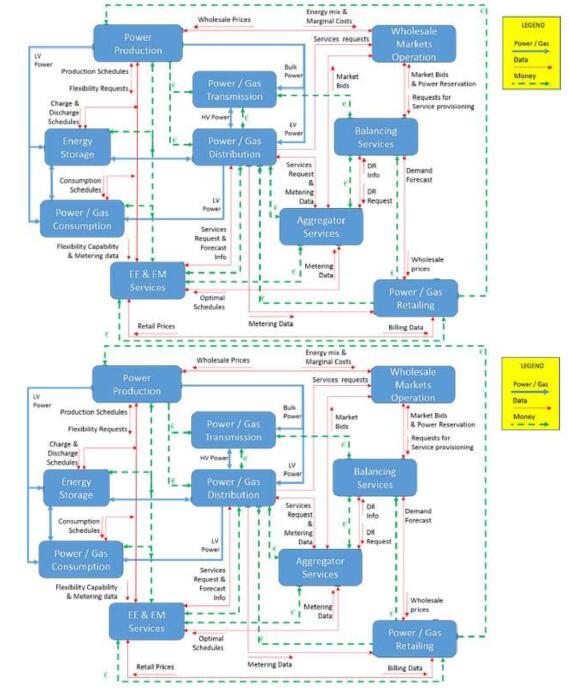
In its current form, the generic value network includes the following "core" business roles:
1. Power Production that is responsible for the power generation, using either fossil fuels or Renewable Energy Sources (RES). This role may include multiple actors independently of their size, i.e. from large power plants to small residential prosumers.
[Page 440]
2. The Power Transmission grid is operated by the Transmission System Operator (TSO)s and provides High-Voltage transmission from the generation units and interconnection services between the distribution grids. The TSO is responsible for the maintenance of the transmission system and must also take the necessary actions (capacity development) to guarantee its ability to satisfy the evolving demand....
3. The Power Distribution grid is operated by the Distribution System Operators (DSO). It is connected with the transmission grid and provides Low (or Medium) Voltage power to end users. The DSO is responsible for operating the transmission system and planning the necessary capacity expansion adequate enough to satisfy the future demand. His role is also crucial for the incorporation of distributed generators in the smart grid.
4. The Wholesale Market Operation combines the information of the production cost and demand forecasting to compute the wholesale prices and propagate them to the generators, the retailers, and the aggregators.
5. The Power Retailers perform the final sale of power to end users. These agents try
Get this document and AI-powered insights with a free trial of vLex and Vincent AI
Get Started for FreeStart Your Free Trial of vLex and Vincent AI, Your Precision-Engineered Legal Assistant
-
Access comprehensive legal content with no limitations across vLex's unparalleled global legal database
-
Build stronger arguments with verified citations and CERT citator that tracks case history and precedential strength
-
Transform your legal research from hours to minutes with Vincent AI's intelligent search and analysis capabilities
-
Elevate your practice by focusing your expertise where it matters most while Vincent handles the heavy lifting

Start Your Free Trial of vLex and Vincent AI, Your Precision-Engineered Legal Assistant
-
Access comprehensive legal content with no limitations across vLex's unparalleled global legal database
-
Build stronger arguments with verified citations and CERT citator that tracks case history and precedential strength
-
Transform your legal research from hours to minutes with Vincent AI's intelligent search and analysis capabilities
-
Elevate your practice by focusing your expertise where it matters most while Vincent handles the heavy lifting
