
- Home
- Books and Journals
- ABA General Library
- Trial Manual for Defense Attorneys in Juvenile Delinquency Cases
Motion for Acquittal (The 'Prima Facie Motion')
| Author | Anthony G. Amsterdam/Martin Guggenheim/Randy A. Hertz |
| Profession | University Professor and Professor of Law at New York University/Fiorello LaGuardia Professor of Clinical Law at New York University School of Law/Professor of Clinical Law at NYU School of Law |
| Pages | 711-713 |
To continue reading
Request your trial- ABA General Library
- Trial Manual for Defense Attorneys in Juvenile Delinquency Cases
- The Nature, Purpose, and Structure of the Manual
- Introduction to Delinquency Practice: The Role of Defense Counsel
- Representing Clients Before Initial Hearing; Steps To Take if a Client Is at the Police Station or Is 'Wanted' by the Police
- The Initial Hearing: Prehearing Interview; Arraignment; Pretrial Detention Arguments; Probable-Cause Hearing
- The Client Interview
- Case Planning: Deciding What Things to Do to Prepare for Trial and the Order in Which to Do Them
- Selecting and Drafting Motions: Strategic and Practical Considerations
- Defense Investigation
- Pretrial Discovery
- Subpoenaing and Preparing Defense Witnesses to Testify at a Motions Hearing or Trial
- Retaining and Working with Expert Witnesses
- Representing Clients Who Are Mentally Ill or Mentally Retarded
- Transfer or Waiver to Adult Court
- Guilty Pleas
- Defense Motions to Advance or for a Continuance; Motions to Dismiss for Want of Prosecution; Speedy Trial Motions
- Motions Hearings; Motions Arguments
- Motions to Dismiss the Charging Paper
- Motions for Severance (or Consolidation) of Counts or Respondents
- Motions to Dismiss for Social Reasons
- Motions for a Change of Venue; Motions for Recusal of the Judge
- Election or Waiver of Jury Trial; Motions Relating to the Jury
- Suppression Hearings
- Motions to Suppress Tangible Evidence
- Motions to Suppress Confessions, Admissions, and Other Statements of the Respondent
- Motions to Suppress Identification Testimony
- Interlocutory Review of Pretrial Rulings by Means of Prerogative Writs
- Trial: General Characteristics; The Opening Stage
- Selecting the Jury at Trial: The Voir Dire
- Opening Statements
- Evidentiary Issues That Are Likely to Arise at Trial
- Handling Prosecution Witnesses
- Motion for Acquittal (The 'Prima Facie Motion')
- Presenting the Case for the Defense
- Objections to Evidence; Motions for Mistrial; Proffers; Rulings on Evidentiary Questions
- The Closing Stage of a Bench Trial: Renewal of the Motion for Acquittal; Closing Argument
- The Closing Stage of a Jury Trial: Renewal of the Motion for Acquittal; Closing Argument; Jury Instructions; the Jury's Deliberations and Verdict
- Postverdict Proceedings
- Dispositions
- Appeal and Post-Disposition Proceedings
- Table of Cases
- Table of Statutes, Rules, Regulations, and Other Authorities
- About the Authors
Subscribers can access the reported version of this case.
You can sign up for a trial and make the most of our service including these benefits.
Why Sign-up to vLex?
-
Over 100 Countries
Search over 120 million documents from over 100 countries including primary and secondary collections of legislation, case law, regulations, practical law, news, forms and contracts, books, journals, and more.
-
Thousands of Data Sources
Updated daily, vLex brings together legal information from over 750 publishing partners, providing access to over 2,500 legal and news sources from the world’s leading publishers.
-
Find What You Need, Quickly
Advanced A.I. technology developed exclusively by vLex editorially enriches legal information to make it accessible, with instant translation into 14 languages for enhanced discoverability and comparative research.
-
Over 2 million registered users
Founded over 20 years ago, vLex provides a first-class and comprehensive service for lawyers, law firms, government departments, and law schools around the world.
Subscribers are able to see a list of all the cited cases and legislation of a document.
You can sign up for a trial and make the most of our service including these benefits.
Why Sign-up to vLex?
-
Over 100 Countries
Search over 120 million documents from over 100 countries including primary and secondary collections of legislation, case law, regulations, practical law, news, forms and contracts, books, journals, and more.
-
Thousands of Data Sources
Updated daily, vLex brings together legal information from over 750 publishing partners, providing access to over 2,500 legal and news sources from the world’s leading publishers.
-
Find What You Need, Quickly
Advanced A.I. technology developed exclusively by vLex editorially enriches legal information to make it accessible, with instant translation into 14 languages for enhanced discoverability and comparative research.
-
Over 2 million registered users
Founded over 20 years ago, vLex provides a first-class and comprehensive service for lawyers, law firms, government departments, and law schools around the world.
Subscribers are able to see a list of all the documents that have cited the case.
You can sign up for a trial and make the most of our service including these benefits.
Why Sign-up to vLex?
-
Over 100 Countries
Search over 120 million documents from over 100 countries including primary and secondary collections of legislation, case law, regulations, practical law, news, forms and contracts, books, journals, and more.
-
Thousands of Data Sources
Updated daily, vLex brings together legal information from over 750 publishing partners, providing access to over 2,500 legal and news sources from the world’s leading publishers.
-
Find What You Need, Quickly
Advanced A.I. technology developed exclusively by vLex editorially enriches legal information to make it accessible, with instant translation into 14 languages for enhanced discoverability and comparative research.
-
Over 2 million registered users
Founded over 20 years ago, vLex provides a first-class and comprehensive service for lawyers, law firms, government departments, and law schools around the world.
Subscribers are able to see the revised versions of legislation with amendments.
You can sign up for a trial and make the most of our service including these benefits.
Why Sign-up to vLex?
-
Over 100 Countries
Search over 120 million documents from over 100 countries including primary and secondary collections of legislation, case law, regulations, practical law, news, forms and contracts, books, journals, and more.
-
Thousands of Data Sources
Updated daily, vLex brings together legal information from over 750 publishing partners, providing access to over 2,500 legal and news sources from the world’s leading publishers.
-
Find What You Need, Quickly
Advanced A.I. technology developed exclusively by vLex editorially enriches legal information to make it accessible, with instant translation into 14 languages for enhanced discoverability and comparative research.
-
Over 2 million registered users
Founded over 20 years ago, vLex provides a first-class and comprehensive service for lawyers, law firms, government departments, and law schools around the world.
Subscribers are able to see any amendments made to the case.
You can sign up for a trial and make the most of our service including these benefits.
Why Sign-up to vLex?
-
Over 100 Countries
Search over 120 million documents from over 100 countries including primary and secondary collections of legislation, case law, regulations, practical law, news, forms and contracts, books, journals, and more.
-
Thousands of Data Sources
Updated daily, vLex brings together legal information from over 750 publishing partners, providing access to over 2,500 legal and news sources from the world’s leading publishers.
-
Find What You Need, Quickly
Advanced A.I. technology developed exclusively by vLex editorially enriches legal information to make it accessible, with instant translation into 14 languages for enhanced discoverability and comparative research.
-
Over 2 million registered users
Founded over 20 years ago, vLex provides a first-class and comprehensive service for lawyers, law firms, government departments, and law schools around the world.
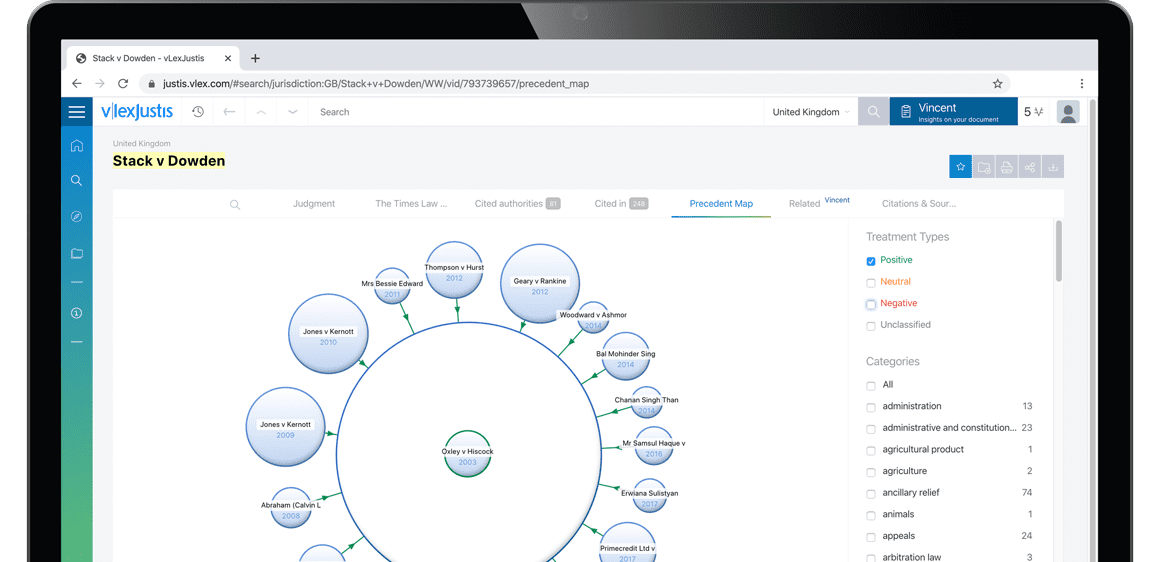
Subscribers are able to see a visualisation of a case and its relationships to other cases. An alternative to lists of cases, the Precedent Map makes it easier to establish which ones may be of most relevance to your research and prioritise further reading. You also get a useful overview of how the case was received.
Why Sign-up to vLex?
-
Over 100 Countries
Search over 120 million documents from over 100 countries including primary and secondary collections of legislation, case law, regulations, practical law, news, forms and contracts, books, journals, and more.
-
Thousands of Data Sources
Updated daily, vLex brings together legal information from over 750 publishing partners, providing access to over 2,500 legal and news sources from the world’s leading publishers.
-
Find What You Need, Quickly
Advanced A.I. technology developed exclusively by vLex editorially enriches legal information to make it accessible, with instant translation into 14 languages for enhanced discoverability and comparative research.
-
Over 2 million registered users
Founded over 20 years ago, vLex provides a first-class and comprehensive service for lawyers, law firms, government departments, and law schools around the world.
Subscribers are able to see the list of results connected to your document through the topics and citations Vincent found.
You can sign up for a trial and make the most of our service including these benefits.
Why Sign-up to vLex?
-
Over 100 Countries
Search over 120 million documents from over 100 countries including primary and secondary collections of legislation, case law, regulations, practical law, news, forms and contracts, books, journals, and more.
-
Thousands of Data Sources
Updated daily, vLex brings together legal information from over 750 publishing partners, providing access to over 2,500 legal and news sources from the world’s leading publishers.
-
Find What You Need, Quickly
Advanced A.I. technology developed exclusively by vLex editorially enriches legal information to make it accessible, with instant translation into 14 languages for enhanced discoverability and comparative research.
-
Over 2 million registered users
Founded over 20 years ago, vLex provides a first-class and comprehensive service for lawyers, law firms, government departments, and law schools around the world.