
Inclusion to Exclusion: Women in Syria
| Citation | Vol. 30 No. 2 |
| Publication year | 2015 |
| topic | Civil Rights |
Inclusion to Exclusion: Women in Syria
Catherine Moore
Tarsila Talarico
This Article will discuss the reasons for the shift from the inclusion of women as active participants in the Syrian revolution to their exclusion and marginalization throughout the conflict and during the recent Geneva II peace negotiations. It will address how the lack of participation of women in such formal negotiations is hindering the peace process, drawing on the role of women, more generally and historically, in conflict resolution. The Article will provide best practices from prior conflicts and ways in which policymakers can improve participation of women in the peace process in Syria. The re-inclusion of Syrian women is possible, despite the ongoing conflict. Based on our research, evidence shows that Syrian women are currently participating in informal conflict resolution processes, despite their exclusion in formal processes. By relying on past successes of women in previous peace processes and with the support of the international and local communities, women can move from informal processes into formal peace negotiations in Syria and elsewhere.
[Page 214]
"Four years. At least 220,000 people killed—more than one every 10 minutes. Millions displaced."1
Since the outbreak of hostilities in Syria, the degradation of violence and stability has only increased with time. With a Security Council that appears to be paralyzed on the issue and with the re-election of Bashar al-Assad on June 4, 2014, many wonder when or if peace will ever come again to Syria. This question is even more pertinent now since the Islamic State of Iraq and Syria (ISIS) controls approximately thirty-five percent of Syria.2
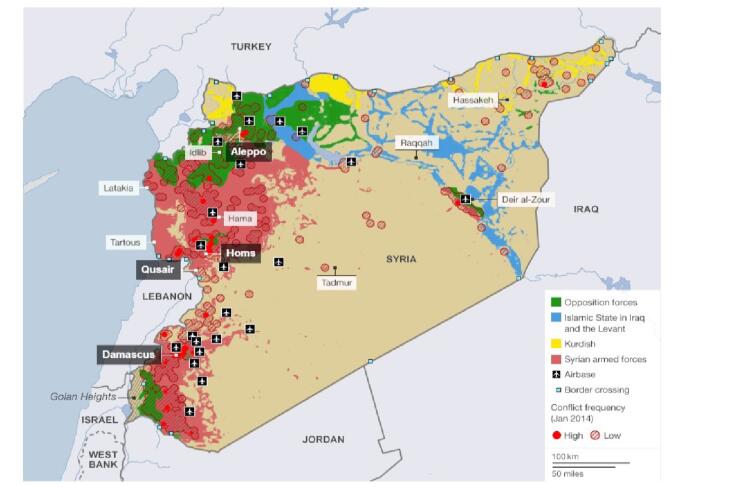
Syria: Mapping the Conflict3
[Page 215]
According to the United Nations (U.N.) High Commission for Refugees, over four million refugees have fled the country since the conflict began in 2011.4 More than fifty percent of those refugees are women and nearly seventy-five percent are children.5 In April 2012 when Kofi Annan struggled to promote a peace plan that provided for a ceasefire—it failed.6 On June 30, 2012, the Action Group for Syria issued an official document called the Geneva Communiqué.7 The Geneva Communiqué identified steps and measures by the parties to secure full implementation of the six-point plan and U.N. Security Council Resolutions (SCR) 20428 and 2043,9 including an immediate cessation of hostilities.10 After chemical weapons attacks in Damascus in August 2013, the U.N. Security Council unanimously adopted Resolution 2118 (2013), which not only demanded the destruction or removal of additional stockpiles of chemical weapons, but also called for the "convening, as soon as possible, of an international conference on Syria to implement the Geneva Communiqué," and for "all Syrian parties to engage seriously and constructively" and commit to the "achievement of stability and reconciliation."11
Although the Geneva Communiqué clearly states that "women must be fully represented in all aspects of the transition,"12 in 2014 the Geneva II Conference on Syria took place in Switzerland, failing to take into account the female perspective. No woman was present during the conference—neither on
[Page 216]
behalf of the Syrian government, nor the Syrian opposition, nor the U.N.13 In this Article we will demonstrate and argue that until women have a seat at the negotiation table and the voices of women are heard, any peace agreement reached in Syria will not be a lasting one.
Historically, Syrian women have often been involved, albeit in a limited role, in societal change within Syria.14 During the Arab Spring, women rose up across the Arab world, including Syria, to protest for change.15 Although women were arrested during the initial protests, many continued to flock to the streets and, even still, encouraged more women to get involved.16 The various roles that women play in conflict are not as obvious as those of their male counterparts, but women often affect change in ways that many men do not even realize.
Peace agreements and reconstruction work better when women are involved in the peacebuilding process. Bringing women to the peace table improves the quality of agreements reached, enhancing the chances that they are successfully implemented.17 The 2002 United Nations Development Fund for Women (UNIFEM) report, "Women, War and Peace: The Independent Experts' Assessment on the Impact of Armed Conflict on Women and Women's Role in Peacebuilding," recommends that women be represented at the negotiating table, making up at least thirty percent of those present.18 Only recently have there been peace negotiations that reached this thirty percent benchmark.19 If the thirty percent quota is a true U.N. requirement, why then are Syrian women being excluded from representation in the Geneva II peace negotiations, which are U.N.-backed peace talks? Research is needed to
[Page 217]
determine the best ways to involve women in the formal negotiations, as well as to encourage their involvement at the local level. A deeper analysis must be made considering the participation of women in peace processes from previous conflicts in order to better incorporate women in these processes in Syria.
Part I of this Article will briefly discuss the importance of women being involved in the peace process by drawing on the extensive literature in this field. It will also define the key processes that exist in conflict resolution literature. Part II will detail the various roles that women have played in Syria throughout modern history, ranging from before the Arab Spring and leading into the current conflict and recent peace negotiations. Part III will provide a comparative perspective on how women have contributed to peace negotiations throughout modern history in an attempt to provide perspective and strategies for women's involvement. Finally, Part IV will draw conclusions from this comparative analysis in an effort to provide best practices to increase participation of Syrian women in the peacebuilding process.
This section will review the literature on the importance of including women in peace negotiations. The negotiation of a peace agreement is considered a milestone and a decisive moment to determine the future of any war-torn country. It can also be extremely difficult to come by, particularly in multi-party non-international armed conflicts, such as Syria. The primary goal of any peace agreement is to find an acceptable compromise between the interests and positions of the warring groups in armed conflict.20 A peace agreement also establishes the legal and political framework for the future of any state.21 The rights of women, especially, are particularly vulnerable at this stage since the future of the state depends on what is negotiated in the peace agreement. Politicians and military advisors, both groups comprised of mostly men, generally negotiate these peace agreements.22 Herein lies the problem—this elite, predominantly male group accounts for the reason why there is so
[Page 218]
little consideration for a female perspective on peace development and implementation.23
The passage of U.N. SCR 1325 (2000) is considered to be the landmark resolution on Women, Peace and Security. It was adopted in October 2000 after the Security Council issued a Presidential Statement on International Women's Day in March 2000 recognizing the link between peace and gender equality, and the fact that women's full participation in peace operations was essential to sustainable peace.24 The Resolution reaffirms the importance of women in both the prevention and resolution of armed conflicts and calls for increased participation of women in the peacebuilding process. The Resolution requires that "all actors involved, when negotiating and implementing peace agreements, to adopt a gender perspective."25 Additionally, the 2002 report of the Secretary-General on Women, Peace and Security, presented to the Security Council, recommended stronger measures to integrate women in all steps of peacekeeping, peacemaking and peacebuilding, and urged the inclusion of a gendered perspective.26 Gender relations and balance are a significant aspect of modern society that is still omitted from peace negotiations, notwithstanding the recognition of its importance by the U.N.27
A gender equal or balanced approach to peace agreements requires that women are able to participate in all stages of the peace process.28 Gender mainstreaming, an equal part of the requirements under U.N. SCR 1325, requires that a "gender perspective is part of every policy consideration . . .
[Page 219]
[including, for example,] the design of a public information campaign, the creation of an advisory body, a draft law, or devising reporting guidelines and priorities."29 By addressing gender balance, however, the recognition and inclusion of gender specific issues will be addressed. Although gender relations are an important aspect of peace agreements, this Article will focus on the need to include women in the peace negotiation process.
Gender balance in peace negotiations requires the inclusion of both women and men at all stages and in all roles within such processes. For example, women can be members of the parties' negotiating teams, mediators, or "friends of the Secretary-General" assisting in the process as advisors, consultants, or as part of any civilian or military implementing body.30 There is also a need to ensure the participation of women at all levels and in all functions of the international agencies present in the post-conflict zone. This includes peacekeeping missions, peacebuilding teams, transitional justice mechanisms, and international development agencies.
A. Phases of Conflict Resolution
There are two phases in conflict...
Get this document and AI-powered insights with a free trial of vLex and Vincent AI
Get Started for FreeStart Your Free Trial of vLex and Vincent AI, Your Precision-Engineered Legal Assistant
-
Access comprehensive legal content with no limitations across vLex's unparalleled global legal database
-
Build stronger arguments with verified citations and CERT citator that tracks case history and precedential strength
-
Transform your legal research from hours to minutes with Vincent AI's intelligent search and analysis capabilities
-
Elevate your practice by focusing your expertise where it matters most while Vincent handles the heavy lifting

Start Your Free Trial of vLex and Vincent AI, Your Precision-Engineered Legal Assistant
-
Access comprehensive legal content with no limitations across vLex's unparalleled global legal database
-
Build stronger arguments with verified citations and CERT citator that tracks case history and precedential strength
-
Transform your legal research from hours to minutes with Vincent AI's intelligent search and analysis capabilities
-
Elevate your practice by focusing your expertise where it matters most while Vincent handles the heavy lifting
