
Ftc Announces Rule Banning Non-competes: How to Proceed
| Citation | Vol. 36-2 |
| Publication year | 2024 |
| Year | 2024 |
Introduction
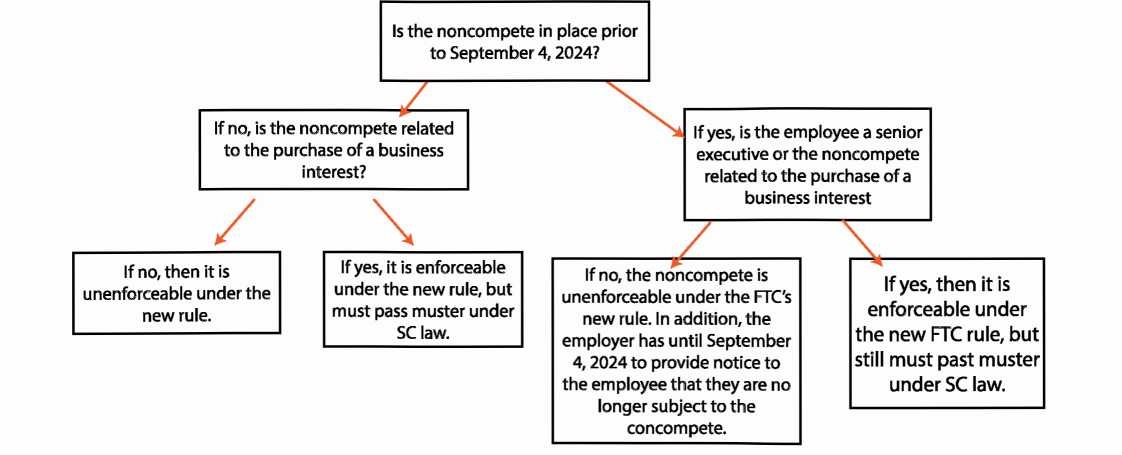
Effective as of September 4, 2024, most non-competition covenants (more commonly known as "non-competes") in the United States will be banned—or will they? On May 7, 2024, the Federal Trade Commission ("FTC") announced a rule[1] that it would be banning employers from entering into, enforcing, or attempting to enforce certain non-competes on the basis that they are an "unfair method of competition."[2] Most importantly, the new rule will be retroactive and, except for certain narrow exceptions for "senior executives," will act to invalidate all existing non-competes.[3]
According to the FTC, in South Carolina alone at least 1,745,274 employees are subject to non-compete agreements in some form or fashion.[4] Since non-competes are standard operating procedures for many companies and their attorneys, it behooves a deeper understanding of the new rules, their breadth, shortcomings, and status.
The New Rule
The new regulations issued by the FTC provide that "with respect to a worker other than a senior executive, it is an unfair method of competition for a person: (i) to enter into or attempt to enter into a non-compete clause; (ii) to enforce or attempt to enforce a non-com-pete clause; or (iii) to represent that the worker is subject to a non-com-pete clause."[5] This new language attempts to invalidate all non-competes on a go forward basis related to all non-sales of a business interest (to be discussed below). Regarding existing non-competes, the FTC has taken an approach that divides employees into two baskets: (1) senior executives and (2) non-senior executives. Concerning any non-senior executive, all non-competes (both retroactive and on a go forward basis) are null and void and constitute an unfair trade practice. However, concerning senior executives, all existing non-competes are still in force and effect, and only those entered into after the effective date will be subject to the new FTC ban.[6]
What is a Senior Executive?
The FTC defines a senior executive as any worker who: (1) was in a policy-making position; and (2) received from a person for the employment: (i) Total annual compensation of at least $151,164 in the preceding year; (ii) if the worker was employed only part of the preceding year but would have received $151,164 when annualized; or (iii) received at least $151,164 of total compensation when annualized in the preceding year before the worker's departure if the worker departed from employment before the preceding year and the worker is subject to a non-compete clause.[7]"Total annual compensation" includes salary, commissions, non-discretionary bonuses, and other non-discretionary bonuses earned during such 52-week period. However, it does not include board, lodging, payments for medical insurance, life insurance, contributions to retirement plans, and "the cost of other similar fringe benefits."[8]
While determining the Total annual compensation for a subject worker is relatively straightforward, the more difficult analysis is whether such person was in a "policy-making position." According to the FTC's new rule a "policy-mak-a business entity's president, chief executive officer or the equivalent, any other officer of a business entity who has policy-making authority or any other natural person who has policy-making authority for the business entity similar to an officer with policy-making authority. An officer of a subsidiary or affiliate of a business entity that is part of a common enterprise who has policy-making authority for the common enterprise maybe deemed to have a policy-making position for purposes of this paragraph. A natural person who does not have policy-making authority over a common enterprise may not be deemed to have a policy-making position even if the person has policy-making authority over a subsidiary or affiliate of a business entity that is part of the common enterprise.[9]
The FTC defines "policy-making authority" as: "final authority to make policy decisions that control significant aspects of a business entity or common enterprise and does not include authority limited to advising or exerting influence over such policy decisions or having final authority to make policy decisions for on a subsidiary of or affiliate of a common enterprise."[10]
The regulations are straightforward for certain executives like a CEO but become less clear with respect to other high-level employees. For example, how would this rule apply to an employee who is not an officer or director of a company but is in charge of the company's social media marketing? In today's marketplace, marketing on social media can make or break the company's success and the employee may be making policy decisions through certain marketing choices, but is that sufficient for the employee to be deemed to be a senior executive if they otherwise meet the requisite Total annual compensation? For larger companies with more complex internal organizational charts, determining which employees are in a policy-making position becomes even less certain. The analysis required to determine whether an employee is considered a senior executive gives additional ammo to savvy attorneys representing both employees and companies in non-compete disputes.
What About Non-Senior Executives?
For all non-equity owning, non-senior executives, the new rule enacted by the FTC is simple— all non-competition clauses are banned (both retroactively and on a go forward basis) and constitute an unfair trade practice.[11] However, the FTC did not stop there. Employers that have subjected their employees to non-competes now have an affirmative duty to notify said employees that they are now released from their non-compete covenants.[12] The notice must be provided to the employee by September 4, 2024, and must: (1) identify the person who entered into the non-com-pete clause with the worker (i.e. the employer), (2) be on paper delivered by hand to the worker, by mail to the workers last known personal street address, by email at an email address belonging to the worker, including the worker's current work email address or last known personal email address, or by text message at a mobile telephone number belonging to the worker.[13] To assist with its new notice requirement, the FTC has provided a safe harbor in the form of a model notice for

employers to use.[14] If an employer utilizes this model notice and delivers the notice as provided above, the employer will be in compliance with the notice requirements of the new regulations.[15]
Exceptions
While the FTC rule at first blush appears all-encompassing, the new regulations do contain an important exception for a "bona fide sale of a business entity."[16] The FTC's new rules conclude that it is not an unfair trade practice to impose or enforce a non-compete with a person who is selling their ownership interest in a business entity, or of all or substantially all of a business entity's operating assets.[17] This leaves open the ability for attorneys and their clients to include non-compete covenants in purchase agreements and any agreement that contains buy-sell language (such as shareholder agreements, operating agreements, etc.). This exception will provide a sigh of relief for those individuals and their attorneys involved in the merger and acquisitions space. One important note is that there is no explanation for how much or what type of equity is sufficient to allow the employer to subject the exiting owner to a non-compete. Presumably, forms of synthetic equity (such as stock appreciation rights) that do not afford the owner any voting, distribution, or liquidation rights would not qualify. But what about tiny forms of non-voting shares in the company (less than 1% of the company's value for instance)? Under the current rules, it appears possible that an employer could issue nominal amounts of non-voting equity to high-level employees on a go forward basis and subject them to a non-competition agreement. To go even further, what about forms of equity that afford the employer the ability to buy out the new owner's equity at a small and/or discounted price? These would appear to be options available to employers to avoid the new ban on non-compete covenants for certain employees.
What About Enforceable Non-Competes?
The new rules state that they only preempt state law to the extent that such laws would otherwise permit or authorize a person to engage in conduct that is an unfair method of competition.[18] What this means is, that for permissible non-competes (i.e. pre-Effective Date non-competes for senior executives and non-competes related to bona fide business sales), there still are state law hurdles that must be cleared for the non-compete to be enforceable.
Courts across the country have historically viewed noncompetition agreements skeptically, with one court writing, "[T]he right of an individual to follow and pursue the particular occupation for which he is best trained is a most fundamental right."[19]
Courts in South Carolina typically utilize a three-pronged approach to determine whether a non-compete is enforceable: (1) whether the restraint, from the standpoint of the employer, is reasonable in the sense that it is no greater than is necessary to protect the employer in some legitimate business interest; (2) from the standpoint of the employee, whether the restraint is reasonable in the sense that it is not unduly harsh and oppressive in curtailing his legitimate efforts to earn a livelihood; and (3) whether the restraint is reasonable from the standpoint of a sound public policy.[20]
Whether the non-compete agreement is valid or not typically is determined by: (1) the length of the non-compete; (2) the breadth of the geographic region referenced in the non-compete; and (3) the breadth of the industry that the employee is restricted from operating in under the non-compete.[21]There is no bright-line rule as to what is valid and enforceable, but rather courts seem to view non-competition covenants on a sliding scale. A longer non-compete presumably maybe enforceable in a narrowly tailored industry and a small geographic region, whereas a short global non-compete would presumably be invalid on its face despite the short time frame.
Existing challenges to the new regulations.
To date, at least four challenges have been filed against the FTC's near-ban on non-competes.[22] Two of the lawsuits were filed in Texas, one in Pennsylvania, and one in Florida. Due to Texas's "first-to-file" rule, the Eastern District of Texas stayed the lawsuit filed by the Chamber of Commerce, and consequently, the Chamber intervened in the lawsuit filed by Ryan, LLC in the Northern District of Texas. Running concurrently, ATS Tree Service, LLC has filed a lawsuit in the Eastern District of Pennsylvania and Properties of the Villages, Inc. has filed a lawsuit in the Middle District of Florida Ocala Division. These lawsuits argue that the FTC's new rule exceeds the FTC's statutory authority and violates constitutional and federal administrative law, among other arguments.
As of August, both the Ryan court and the Properties of the Villages court have decided in favor of the challengers to the new regulations. The court in the Properties of the Villages case issued a preliminary injunction in favor of the plaintiffs on the ground that the new regulations implicated the major questions doctrine, which requires congressional authorization for regulations that have major political or economic significance. The Ryan court invalidated the FTC rule, and issued a nationwide injunction, which halts the implementation of the regulations beginning in September. Conversely, the ATS Tree Services court denied the request for preliminary injunction and found that the new regulations fell within the FTC's core mandate and that the major questions doctrine was therefore inapplicable.
If the FTC appeals the decision in Ryan or Properties of the Villages, there is likely to be a break among the Federal Circuit Courts of Appeal, which would be ripe for a Supreme Court challenge. In the meantime, there may be conflicting decisions regarding whether to proceed

with implementation of the rules under the new regulations.
What To Do Going Forward.
While non-competition agreements have been significantly restricted under the new regulations, practitioners should not abandon non-competes across the board. If the FTC's new rule is to stand, practitioners should ask the following questions in determining whether to include, and how to effectively draft, non-competes:
• Determine whether you have existing non-competes. Are the non-competes for senior executives?
• Consider issuing equity in Company to key employees. This should be considered on a case-by-case basis.
• Be sure to include non-competition clauses in any operating agreements, shareholder agreements, purchase agreements, etc.
As there may be inconsistencies among the decisions of the various Circuits hearing challenges to the new FTC rule, it is important to also note the penalties for failure to comply with the new regulations. The FTC Act[23] allows the FTC to obtain equitable remedies including: (1) Cease-and-desist orders issued by the FTC after an administrative hearing; (2) Consent orders settling administrative complaints; and (3) Judicial orders. With that being said, an important note is that the FTC cannot obtain civil penalties or other monetary relief against employers merely for violations of the new FTC rule. Instead, the FTC is entitled to seek monetary remedies in some situations, including civil fines, for failure to comply with orders after the FTC has proceeded through the administrative process of issuing a cease-and-desist and entering an order for the cited violation to halt. The FTC can impose a civil penalty amount of up to $51,744 in 2024 for violations of orders issued under the FTC Act.[24] In addition, each day of continuance of such failure or neglect shall be deemed a separate offense.
With challenges to the new regulations continuing to make their way through the court system, and the 4th Circuit Court of Appeals yet to weigh in, practitioners representing employers will likely find it prudent to continue to include non-compete clauses as a matter of course if the court determines that the FTC has exceeded its authority in issuing the new regulations. However, employers and employees should carefully monitor the status of the pending litigation.

Michelle King and David Thompson are attorneys with Mer-line &Meacham, PA in Greenville. Michelle focuses her practice on complex estate planning and

business strategy. David's practice is focused on the areas of Taxation, Estate Planning, Business Organizations, and Probate.
---------
Notes:
[2] See generally Id.
[3] See 16 C.F.R. § 910.2.
[4] 16 C.F.R. Part 910 Appendix Table A.l.
[5] See 16 C.F.R. § 910.2(a)(1).
[6] See 16 C.F.R. § 910.2(a)(2)(iii).
[7] See 16 C.F.R. § 910.1.
[8] Id.
[9] Id.
[10] Id.
[11] See generally 16 C.F.R. § 910.2(a)(1).
[12] See 16 C.F.R. § 910.2(b)(1).
[13] See 16 C.F.R. § 910.2(b)(2).
[14] See 16 C.F.R. § 910.2(b)(4).
[15] See 16 C.F.R. § 910.2(b)(6).
[17] Id.
[19] Carolina Chemical Equipment Company v. Mucin enpuss, 322 S.C. 289 (citing ILG Industries u. Scott, 49 Ill.2d 88, 273 N.E.2d 393, 396 (1971)).
[20] See Standard Register Co. u. D.C. Kerrigan, 238 S.C. 54 at 60, 119 S.E.2d 533 at 536 (1961).
[21] See e.g. Sermons u. Caine &Estes Insurance Agency, Inc., 275 S.C. 506, 273 S.E.2d 338 (1980).
[22] See Ryan, LLC u. FTC, Case No. 3:24-cv-00986-E, N.D. Tex.; Chamber op Commerce u. FTC, CASE NO. 6:24-cv-00148, E.D. Tex.; ATS Tree Services, LLC u. FTC, Case No. 2:2024cv01743, E.D. Penn.; and Properties op the Villages, Inc. a FTC, Case No. 5:24-cv-316-TJC-PRL.
[24] FTC Publishes Inflation-Adjusted Civil Penalty Amounts for 2024, Federal Trade Comm'n (Jan 11, 2024) www.ftc.gov/news-events/news/ press-releases/2024/01/ftc-publishes-inflation-adjusted-civil-penalty-amounts-2024 (last visited September 5, 2024).
---------
Start Your Free Trial of vLex and Vincent AI, Your Precision-Engineered Legal Assistant
-
Access comprehensive legal content with no limitations across vLex's unparalleled global legal database
-
Build stronger arguments with verified citations and CERT citator that tracks case history and precedential strength
-
Transform your legal research from hours to minutes with Vincent AI's intelligent search and analysis capabilities
-
Elevate your practice by focusing your expertise where it matters most while Vincent handles the heavy lifting
