
Chapter 7 Getting the Tenant Moved in
| Library | Every Landlord's Legal Guide (Nolo) (2022 Ed.) |
CHAPTER 7 Getting the Tenant Moved In
Inspect the Rental Unit
Use a Landlord-Tenant Checklist
How to Fill Out the Checklist
Sign the Checklist
Photograph or Video the Rental Unit
Send New Tenants a Move-In Letter
Cash Rent and Security Deposit Checks
Organize Your Tenant Records
How to Establish a Filing System
How to Handle Credit Reports
How to Respond to Security Breaches
Organize Income and Expenses for Schedule E
Using Email for Notices or Other Communications With Tenants
On the One Hand: Electronic Notice Is Acceptable in Most Situations
On the Other Hand: Emails and Texts Might Be Legal, But Demonstrating Their Receipt Might Not Be Easy
The Bottom Line: Stick With a Traditional Mail or Delivery Service
FORMS IN THIS CHAPTER
Chapter 7 includes instructions for and samples of the following forms:
• Landlord-Tenant Checklist
• Move-In Letter
The purchase of this book includes free downloadable and customizable copies of both of these forms. See Appendix B for the download link and instructions.
A clearly written lease or rental agreement, signed by all adult occupants, is the foundation of a strong tenancy. But establishing a dispute-free relationship based on mutual understanding requires more. In addition to signing a solid lease or rental agreement, you'll want to:
• inspect the property with the tenant and fill out a Landlord-Tenant Checklist, and
• prepare a move-in letter highlighting important terms of the tenancy and your expectations.
To find out if your state requires a landlord-tenant checklist documenting the unit's condition, check the "Required Landlord Disclosures" chart in Appendix A.
Inspect the Rental Unit
To reduce the potential for future arguments, you (or your representative) and the new tenants (together, if possible) should inspect the rental for damage and obvious wear and tear before the tenants move in.
During the inspection, document what you see. Using a Landlord-Tenant Checklist, discussed below, is one of the most straightforward ways of recording the unit's condition.
In some states, the law requires you to give new tenants a written statement on the condition of the premises at move-in time, including a comprehensive list of existing damage.
Tenants in many of these states have the right to inspect the premises after receiving the landlord's list, and to note any problems or disagreements.
Even if a move-in inspection with documentation isn't legally required, you should consider it an essential part of creating a thorough file on the tenancy.
Use a Landlord-Tenant Checklist
When the tenant moves out, if you discover damage, you'll want to use the tenant's security deposit to cover the repair costs. Without thorough documentation, it will be difficult to prove that the tenant caused the damage—how will you show that the damage didn't exist when the tenant moved in?
A Landlord-Tenant Checklist provides the written record you'll need to support charging a tenant for damages to the rental. It can also serve as a key piece of evidence in the event you find yourself in a court battle over the security deposit. Our form includes a recital at the end that documents the presence of working smoke detectors and carbon monoxide detectors, along with an acknowledgment that you may enter to inspect and maintain them.
Coupled with a system to regularly keep track of the rental property's condition, the checklist will also be extremely useful if a tenant withholds rent, breaks the lease and moves out, or sues you outright based on a claim that the unit needs substantial repairs or isn't habitable. See Chapter 9 for instructions and forms that will let you stay updated on the condition of your rental properties.
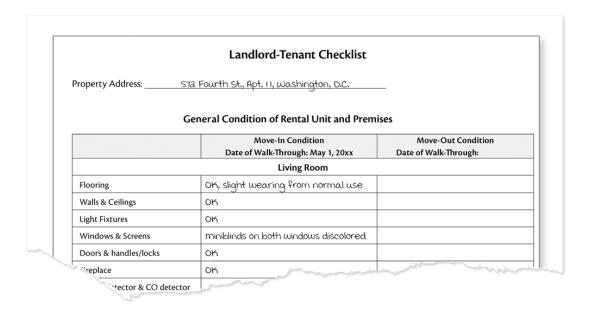
A portion of our Landlord-Tenant Checklist is shown below, and the Nolo website includes free, customizable downloads for furnished and unfurnished property. See Appendix B for the link to the forms in this book.
How to Fill Out the Checklist
You and the tenants should fill out the checklist together. If that's impossible, complete the form and give it to the tenants to review. The tenant should note any disagreement and return it to you within a few days.
The checklist is in two parts: the General Condition of Rental Unit and Premises, and Checklist for Furnished Property. If your rental is not furnished, you can delete the second part. If your rental is fully or significantly furnished, you'll want to use this part of the checklist to inventory and describe the included items.
You can delete items that aren't present in your rental, or you can place "N/A" in the applicable box. You can also add as many items or rooms to the checklist as you need.
You will be filling out the first column—Move-In Condition—on or before the tenant's move-in date. You'll fill out the second column—Move-Out Condition —when the tenant moves out and you inspect the unit again.
You can change the entries by adding or deleting rows...
Get this document and AI-powered insights with a free trial of vLex and Vincent AI
Get Started for FreeStart Your Free Trial of vLex and Vincent AI, Your Precision-Engineered Legal Assistant
-
Access comprehensive legal content with no limitations across vLex's unparalleled global legal database
-
Build stronger arguments with verified citations and CERT citator that tracks case history and precedential strength
-
Transform your legal research from hours to minutes with Vincent AI's intelligent search and analysis capabilities
-
Elevate your practice by focusing your expertise where it matters most while Vincent handles the heavy lifting

Start Your Free Trial of vLex and Vincent AI, Your Precision-Engineered Legal Assistant
-
Access comprehensive legal content with no limitations across vLex's unparalleled global legal database
-
Build stronger arguments with verified citations and CERT citator that tracks case history and precedential strength
-
Transform your legal research from hours to minutes with Vincent AI's intelligent search and analysis capabilities
-
Elevate your practice by focusing your expertise where it matters most while Vincent handles the heavy lifting
