
CHAPTER 5 - § 5.03
| Jurisdiction | United States |
§ 5.03 TRAFFIX AND FUNCTIONALITY
Having laid to rest the circuit split over inherent distinctiveness in Wal-Mart, the Supreme Court next set its sights on another hotly contested topic in trade dress litigation—the defense of functionality.
While it has not always been the case, the Lanham Act presently provides that in order to obtain registration of trademarks or trade dress on the Principal Register, the mark or dress in question must not comprise "any matter that, as a whole, is functional."72 Similarly, the Lanham Act provides that, in a civil action for infringement, the party asserting the trade dress must carry the burden of proving that the dress is not functional.73
Thus, it was clear even prior to the TrafFix decision that functional trade dress designs would not be eligible for protection, even where a secondary meaning had been established. However, determining whether a particular trade dress is functional is often a complicated exercise. Indeed, in the years leading up to TrafFix, there was dispute among the appeals courts on the issue of whether a design that was claimed in an expired patent should be automatically denied protection as functional trade dress.
The foundation for determining whether trade dress was functional was set forth in two Supreme Court cases—Inwood Labs v. Ives Labs and Qualitex v. Jacobson.74 Inwood Labs related to the functionality of the color of a pharmaceutical capsule.75 There the Supreme Court held that the color was functional on the basis that it assisted physicians and patients in identifying the medication and dosage and reduced patient anxiety and confusion associated with receiving medicine of an unknown color.76 In a footnote, the Court offered a brief definition of a functional characteristic: "an important ingredient in the commercial success of the product" such that it is "essential to the use or purpose of the article or ... affects the cost or quality of the article."77 This functionality test is often referred to as the Inwood Labs test, or the "cost or quality" test.
The Supreme Court next revisited the Inwood Labs functionality test about thirteen years later, in Qualitex v. Jacobson. Qualitex dealt with the trade dress claimed in a green-gold color used on pads for dry cleaning presses.78 The Court found that the color was not essential to the use of the press pad and did not affect its cost or quality—it passed the Inwood Labs test.79 The Court did not, however, stop there. The Court posited an entirely new test for functionality, one that asked whether "exclusive use of the feature would put competitors at a significant non-reputation-related disadvantage." This functionality test is sometimes referred to as the Qualitex test, or the "competitive need" test. Applying the Qualitex test, the Court found that while the use of some color on press pads was acknowledged as important to avoid noticeable stains, many different colors would sufficiently hide the stains.80 Accordingly, as the Court found that there was no competitive need to use the green-gold color, the plaintiff was entitled to exclusive use of the same.81
As one might imagine, the marked differences between the Inwood Labs and Qualitex tests for functionality created much uncertainty in the lower courts during this time period. Some courts applied Inwood Labs exclusively, some applied Inwood Labs selectively, and still others applied Inwood Labs and Qualitex together in a stepwise fashion. Some saw the Supreme Court's grant of certiorari in TrafFix as golden opportunity to fashion a single test for all to follow. Instead, the Supreme Court may have created even more confusion with its ruling.
The TrafFix case related to temporary road signs bearing warnings like "Road Work Ahead" or "Shoulder Closed" that are commonly seen along roadways during construction.82 The problem with the temporary signs that were available before the plaintiff (Marketing Displays) entered the market was that they were prone to being knocked over by strong gusts of wind.83 Seeing a need for road signs that remained upright and provided adequate warnings to motorists even during extreme weather conditions, inventor Robert Sarkisian designed a new support mechanism.84 The mechanism was built upon two springs (the dual-spring design) that provided sufficient flexibility to keep the signs from being blown over.85 As no other road signs on the market included this dual-spring design, Sarkisian applied for and obtained two utility patents covering the spring mechanism.86 Images from those two utility patents (US Pat. Nos. 3,646,696 and 3,662,482) are shown below.
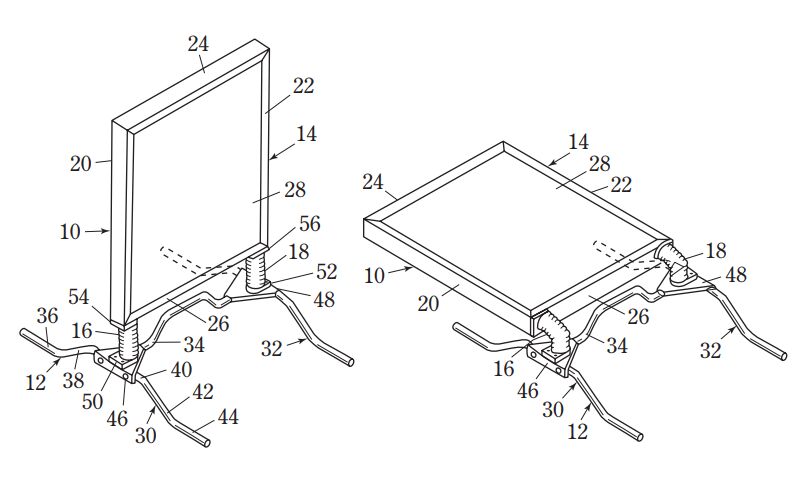
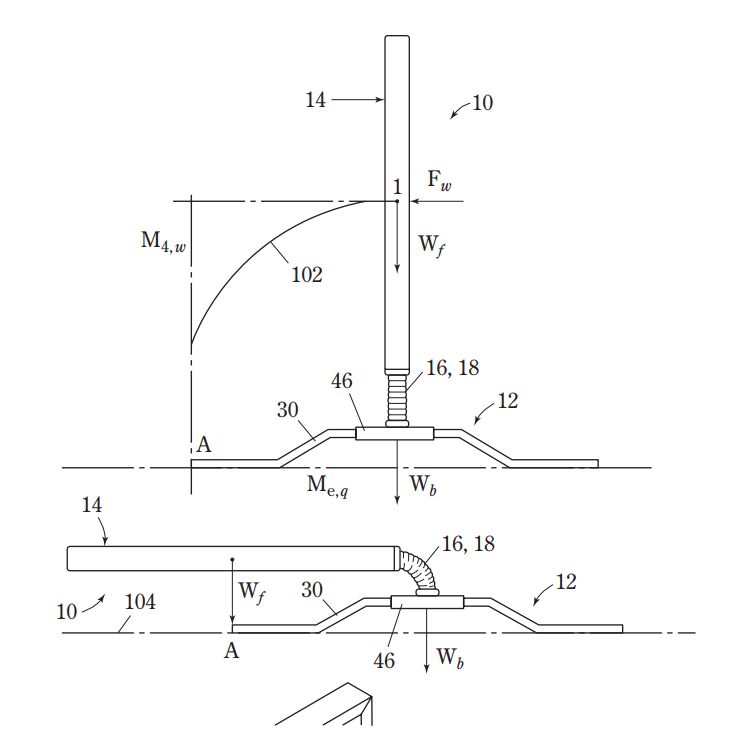
Ownership of the utility patents was later assigned by Sarkisian to Marketing Displays, which successfully sold Windmaster road signs with the dual-spring mechanism until the patents expired.87 After the patents expired, TrafFix Devices copied the dualspring design and starting selling its own wind-resistant Windbuster sign stands.88 In response, Marketing Displays brought suit against TrafFix under the Lanham Act on the grounds of trademark infringement (based on the use of similar product names), trade dress infringement (based on the copied dual-spring design), and unfair competition.89 On the issue of secondary meaning, Marketing Displays claimed that customers recognized their products because of the visibility of the dual-spring base.90
The district court initially ruled against Marketing Displays on its trade dress claim, granting TrafFix summary judgment for separate two reasons.91 First, it held that the trade dress at issue was the dual-spring design and...
Get this document and AI-powered insights with a free trial of vLex and Vincent AI
Get Started for FreeStart Your Free Trial of vLex and Vincent AI, Your Precision-Engineered Legal Assistant
-
Access comprehensive legal content with no limitations across vLex's unparalleled global legal database
-
Build stronger arguments with verified citations and CERT citator that tracks case history and precedential strength
-
Transform your legal research from hours to minutes with Vincent AI's intelligent search and analysis capabilities
-
Elevate your practice by focusing your expertise where it matters most while Vincent handles the heavy lifting

Start Your Free Trial of vLex and Vincent AI, Your Precision-Engineered Legal Assistant
-
Access comprehensive legal content with no limitations across vLex's unparalleled global legal database
-
Build stronger arguments with verified citations and CERT citator that tracks case history and precedential strength
-
Transform your legal research from hours to minutes with Vincent AI's intelligent search and analysis capabilities
-
Elevate your practice by focusing your expertise where it matters most while Vincent handles the heavy lifting
