
Chapter 15 Returning Security Deposits and Other Move-out Issues
| Library | Every Landlord's Legal Guide (Nolo) (2022 Ed.) |
CHAPTER 15 Returning Security Deposits and Other Move-Out Issues
Preparing a Move-Out Letter
Inspecting the Unit When a Tenant Leaves
Applying the Security Deposit to the Last Month's Rent
Basic Rules for Returning Deposits
Deductions for Cleaning and Damage
Reasonable Deductions
Common Disagreements
Deductions for Unpaid Rent
Month-to-Month Tenancies
Fixed-Term Leases
Deducting Rent After You've Evicted a Tenant
Preparing an Itemized Statement of Deductions
Sample 1: Returning the Entire Deposit
Sample 2: Itemizing Deductions for Repairs, Cleaning, and Related Losses
Sample 3: Itemizing Deductions for Repairs, Cleaning, and Unpaid Rent
Handling Deposits When a Tenant Files for Bankruptcy
Mailing the Security Deposit Itemization
Security Deposits From Cotenants
If a Tenant Sues You
How Long Tenants Have to File Suit
Settling a Potential Lawsuit
Preparing for a Small Claims Court Hearing
Penalties for Violating Security Deposit Laws
When the Deposit Doesn't Cover Damage and Unpaid Rent
The Demand Letter
Should You Sue?
Ex-Tenants Who Have Moved Out of State
Can the Small Claims Court Hear Your Case?
Can You File Your Case in Your Local Court?
Finding and Serving Your Ex-tenant
Collecting If You Win
What to Do With Property Abandoned by a Tenant
Why Has the Tenant Left?
When the Tenant Owes You Money
Legal Notice Requirements
How to Handle Abandoned Property When Tenants Don't Respond
Landlord Liability for Damage to Tenants' Property
FORMS IN THIS CHAPTER
Chapter 15 includes instructions for and samples of the following forms:
• Move-Out Letter
• Letter for Returning Entire Security Deposit
• Security Deposit Itemization (Deductions for Repairs and Cleaning)
• Security Deposit Itemization (Deductions for Repairs, Cleaning, and Unpaid Rent)
The purchase of this book includes free downloadable and customizable copies of all of these forms. See Appendix B for the download link and instructions.
Fights over security deposits account for a large percentage of landlord-tenant disputes. Failure to return security deposits as legally required can result in substantial financial penalties if a tenant files suit. This chapter will walk you through some simple steps to minimize the possibility that you'll spend hours in court.
We cover key aspects of state security deposit laws in this chapter and in Chapter 4. Check local ordinances in all areas where you own property. Many cities—particularly those with rent control—add their own rules on security deposits.
RELATED TOPIC
Related topics covered in this book include:
• How to avoid deposit disputes by using clear lease and rental agreement provisions: Chapter 2
• Deposit limits; requirements for keeping deposits in a separate account or paying interest; last month's rent and deposits: Chapter 4
• Highlighting security deposit rules in a move-in letter to new tenants; taking photographs and using a Landlord-Tenant Checklist to keep track of the condition of the premises before and after the tenant moves in: Chapter 7
• Notice requirements for terminating a tenancy: Chapter 14
• State Security Deposit Rules: Appendix A.
Preparing a Move-Out Letter
Chapter 7 explains how a move-in letter can help get a tenancy off to a good start. Similarly, a move-out letter can help reduce the possibility of disputes over the return of security deposits.
Your move-out letter should tell tenants how you expect the unit to be left, explain your inspection procedures, list the kinds of deposit deductions you can legally make, and tell tenants when and how you will send any refund that is due.
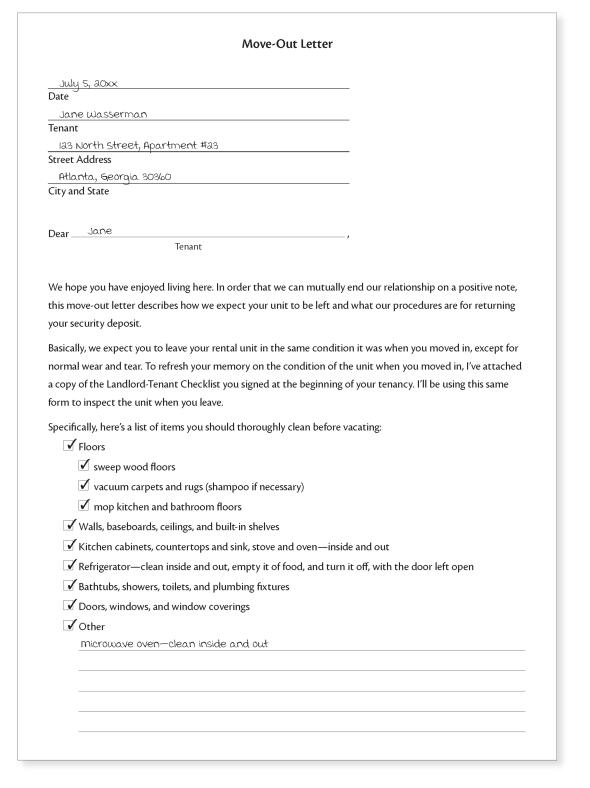
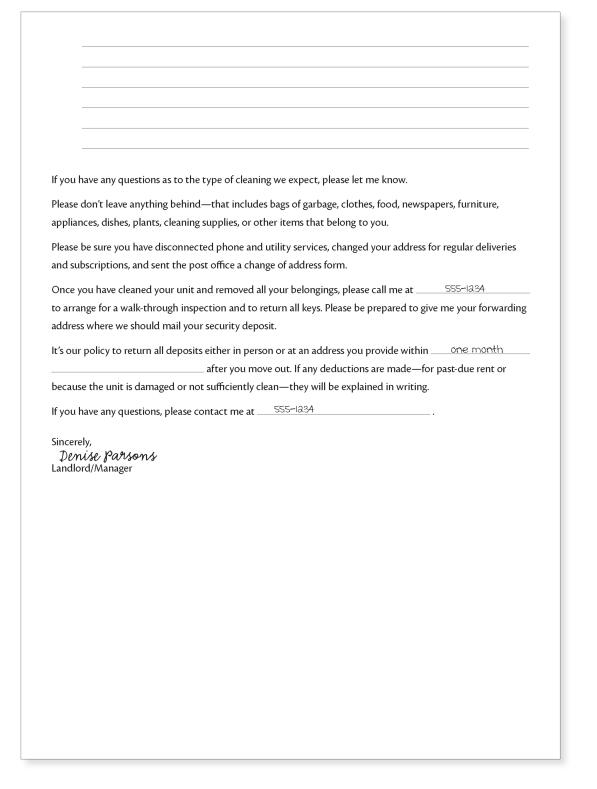
A sample Move-Out Letter is shown below and the Nolo website includes a downloadable copy. See Appendix B for the link to the forms in this book. You might want to add or delete items depending on your own needs and how specific you wish to be.
Here are a few points to consider including in a move-out letter:
• specific cleaning requirements, such as what to do about dirty walls, or how to fix holes left from picture hooks
• instructions regarding recycling and disposing of paint and household hazardous wastes
• a reminder that fixtures (items that tenants attach more or less permanently to the wall, such as built-in bookshelves) must be left in place (see the discussion of fixtures in Chapter 9 and Clause 12 of the form agreements in Chapter 2)
• details about how and when the final inspection will be conducted
• a request for a forwarding address where you can mail the deposit
• information about state laws (if any) that allow a landlord to keep a security deposit when the tenant doesn't supply a forwarding address within a certain amount of time ("Mailing the Security Deposit Itemization," below), and
• information on state laws regarding abandoned property (discussed at the end of this chapter).
Inspecting the Unit When a Tenant Leaves
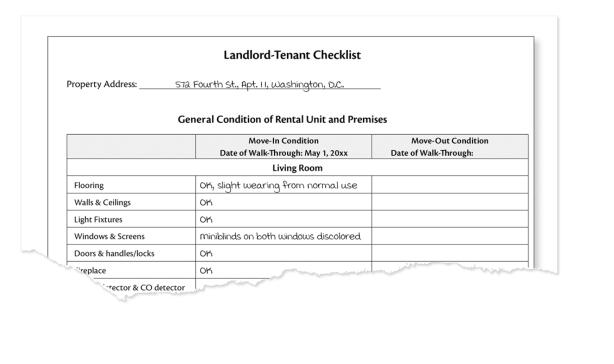
After tenants leave, you will need to inspect the unit for needed cleaning and damage repair. At the final inspection, check each item addressed in the Landlord-Tenant Checklist you and the tenants (hopefully) signed at move-in. (An excerpt is shown below. See Chapter 7 for a complete checklist.) Note any item that needs cleaning, repair, or replacement in the right column, Move-Out Condition.
Many landlords do a final inspection on their own and simply send tenants an itemized statement with any remaining balance of the deposit. If at all possible, we recommend that you perform the inspection with the tenants, rather than by yourself. A few states actually require this. Doing the final inspection with the tenants present (in a conciliatory, nonthreatening way) will eliminate any uncertainty about what deductions (if any) you propose to make from the deposit. It also gives tenants a chance to present their point of view. But, best of all, this approach reduces the risk that tenants who feel unpleasantly surprised by the amount you withhold from the deposit will promptly take the matter to small claims court.
If you have any reason to believe a tenant will take you to court over your security deposit deductions, have the unit examined by another, more neutral person. This person should be available to testify in court on your behalf, if necessary, should you end up in small claims court.
TIP
Photograph "before" and "after." In Chapter 7, we recommend that you take photos or videos of the unit before tenants move in. You should do the same when tenants leave, so that you can make comparisons and have visual proof in case you are challenged later in court.
To be on the safe side, keep your inspection notes, photos, videos, and related records for at least two years. Technically speaking, in most states tenants have up to four years to sue you over security deposit agreements, but the chances of former tenants suing after a year or so has passed are slim.
Many tenants, faced with losing a large chunk of their security deposit, will ask for the chance to do some more cleaning or repair any damage you've identified in the final inspection. A few states require you to offer tenants a second chance at cleaning before you deduct cleaning charges from the security deposit. Even if your state doesn't require it, you might wish to offer a second chance if the tenant seems sincere and capable of doing the work. Th is could help avoid arguments and maybe even a small claims action. But, if you need to get the apartment ready quickly for a new tenant or doubt the tenant's ability to do the work, just say no. And think twice if repairs are required, not just cleaning. If a tenant does a repair poorly, you might end up having to do it over.
Applying the Security Deposit to the Last Month's Rent
When giving notice, a tenant might ask you to apply the security deposit toward the last month's rent. Unless a portion of the tenant's deposit was designated to pay the last month's rent, though, you're not legally obliged to apply it in this way.
Think twice before agreeing to apply a deposit you are already holding towards the last month's rent. The problem is that you don't know what the property will look like when the tenant leaves. If the tenant leaves the property a mess, but the whole security deposit has gone to pay the last month's rent, you'll have nothing left to use to repair or clean the property. You will have to absorb the loss or sue the tenant.
If, despite the above advice, you're inclined to allow the deposit to serve as last month's rent, tell the tenant that you'll need to make a quick inspection first. If you perform the inspection and think that the tenant will leave the property clean and undamaged, you can agree to the request. Send the tenant a written statement describing how you applied the deposit to the last month's rent.
Some tenants will not pay the last month's rent in spite of your refusal to go along with the request, in hopes that you'll use the deposit anyway. You can instead treat the tenant's nonpayment (or partial payment) of the last month's rent as an ordinary case of rent nonpayment. This means preparing and serving the notice necessary to terminate the tenancy, and, if the tenant doesn't pay, following up with an eviction lawsuit. But because it typically takes at least several weeks to evict a tenant, this probably won't get the tenant out much sooner than planned. However, it will provide you with a court judgment for the unpaid last month's rent. Having a judgment means that you can use the security deposit to pay for cleaning and repair costs, and apply any remainder to the judgment for nonpayment of rent. If there's still rent money owed, you can attempt to enforce the judgment, as discussed below ("When the Deposit Doesn't Cover Damage and Unpaid Rent").
Basic Rules for Returning Deposits
The general rule is that you're entitled to deduct from a tenant's security deposit whatever amount you need to fix damaged or dirty property (outside of "ordinary wear and tear") or to make up...
Get this document and AI-powered insights with a free trial of vLex and Vincent AI
Get Started for FreeStart Your Free Trial of vLex and Vincent AI, Your Precision-Engineered Legal Assistant
-
Access comprehensive legal content with no limitations across vLex's unparalleled global legal database
-
Build stronger arguments with verified citations and CERT citator that tracks case history and precedential strength
-
Transform your legal research from hours to minutes with Vincent AI's intelligent search and analysis capabilities
-
Elevate your practice by focusing your expertise where it matters most while Vincent handles the heavy lifting

Start Your Free Trial of vLex and Vincent AI, Your Precision-Engineered Legal Assistant
-
Access comprehensive legal content with no limitations across vLex's unparalleled global legal database
-
Build stronger arguments with verified citations and CERT citator that tracks case history and precedential strength
-
Transform your legal research from hours to minutes with Vincent AI's intelligent search and analysis capabilities
-
Elevate your practice by focusing your expertise where it matters most while Vincent handles the heavy lifting
