
Chapter 14 Ending a Tenancy
| Library | Every Landlord's Legal Guide (Nolo) (2022 Ed.) |
CHAPTER 14 Ending a Tenancy
Changing Lease or Rental Agreement Terms
Amending a Month-to-Month Rental Agreement
Preparing a New Rental Agreement
How Month-to-Month Tenancies End
Giving Notice to the Tenant
How Much Notice the Tenant Must Give You
Insist on a Tenant's Written Notice of Intent to Move
Accepting Rent After a 30-Day Notice
When the Tenant Doesn't Give the Required Notice
When You or Your Tenant Violates the Rental Agreement
How Leases End
Giving Notice to the Tenant
When the Tenant Continues to Pay Rent After the Lease Expires
When a Lease Ends and You Want the Tenant Out
When the Tenant Breaks the Lease
Is the Tenant Really Gone?
When Breaking a Lease Is Justified
Your Duty to Mitigate Your Loss When the Tenant Leaves Early
When You Can Sue
Termination Fees
A Tenant's Death: Consequences for Cotenants and the Landlord's Duties
Death of a Tenant With No Cotenants: Requests for the Tenant's Property
Death of a Tenant With Cotenants or Subtenants: Requests for the Tenant's Property.....315
What Happens to the Lease or Rental Agreement?
What Happens to the Deceased Tenant's Security Deposit?
Condominium Conversions
FORMS IN THIS CHAPTER
Chapter 14 includes instructions for and samples of the following forms:
• Amendment to Lease or Rental Agreement
• Tenant's Notice of Intent to Move Out
• Indemnification of Landlord
The purchase of this book includes free downloadable and customizable copies of all of these forms. See Appendix B for the download link and instructions.
Most tenancies end because the tenant leaves voluntarily. Some tenants give proper legal notice and leave at the end of a lease term; others aren't so thoughtful and give inadequate notice, break the lease for a trumped-up reason, or just move out in the middle of the night. And, of course, some tenants fail to live up to their obligations for reasons they can't control—for example, when a tenant dies during the tenancy.
As a landlord, you should understand the important legal issues that arise at the end of a tenancy, including:
• the type of notice a landlord or tenant must provide to end a month-to-month tenancy
• your legal options if a tenant doesn't leave after receiving (or giving) a termination notice or after the lease has expired
• what happens when a tenant leaves without giving required notice, and
• the effect of a condominium conversion on a tenant's lease.
This chapter starts with a brief discussion of a related topic—how to legally change a lease or rental agreement during a tenancy.
RELATED TOPIC
Related topics covered in this book include:
• How to advertise and rent property before a current tenant leaves: Chapter 1
• Writing clear lease and rental agreement provisions on notice required to end a tenancy: Chapter 2
• Raising the rent: Chapter 3
• Highlighting notice requirements in a move-in letter to the tenant: Chapter 7
• Handling tenant requests to sublet or assign the lease, and what to do when one cotenant leaves: Chapter 8
• Tenant's right to move out if the rental unit is damaged or destroyed: Chapter 9
• Preparing a move-out letter and returning security deposits when a tenant leaves, and how to deal with any abandoned property: Chapter 15
• How and when to prepare a warning letter before terminating a tenancy: Chapter 16
• Terminating a tenancy when a tenant fails to leave after receiving a 30-day notice or violates the lease or rental agreement—for example, by not paying rent: Chapter 17
• State Rules on Notice Required to Change or End a Tenancy: Appendix A.
Changing Lease or Rental Agreement Terms
Once you sign a lease or rental agreement, you've created a legal contract between you and your tenant.
If you use a lease, you cannot unilaterally change the terms of the tenancy for the length of the lease. For example, you can't raise the rent unless the lease allows it or the tenant agrees.
If the tenant agrees to changes, however, you can make the changes in the same manner described below for changes to month-to-month agreements. All changes should be in writing and signed by each of you.
Amending a Month-to-Month Rental Agreement
You don't need a tenant's consent to change something in a month-to-month rental agreement. Legally, you need only send the tenant a notice of the change. The most common reason landlords amend a rental agreement is to increase the rent.
To change a month-to-month tenancy, most states require 30 days' notice, subject to any local rent control ordinances (see "State Rules on Notice Required to Change or Terminate a Month-to-Month Tenancy" in Appendix A for a list of each state's notice requirements). You'll need to consult your state statutes for the specific requirements for delivering the notice to the tenant. Most states allow you to deliver the notice by first-class mail.
TIP
Contact the tenant and explain the changes. It makes good personal and business sense for you or your manager to notify tenants personally about a rent increase or other changes before you send them a written notice. That way, you'll be able to give a bit of explanation for the changes and address any concerns.
You usually don't need to redo the entire rental agreement in order to make a change or two. It's just as legal and effective to attach a copy of the notice making the change to the rental agreement. However, in some situations you might want the change to appear on the written rental agreement itself.
If the change is small and simply alters part of an existing clause—such as increasing the rent or making the rent payable every 14 days instead of every 30 days—you can cross out the old language in the rental agreement, write in the new, and sign in the margin next to the new words. Make sure the tenant also signs next to the change. Add the date, in case there is a dispute later as to when the change became effective.
EXAMPLE: On February 1, Sam gave his tenant notice that the rent will increase to $2,000 as of May 1. Sam gave the correct amount of notice, which was 30 days. Next to the rent clause in the original rental agreement, Sam wrote "As of May 1, 20XX, the rent will be $2,000." Sam and the tenant sign in the margin of the original agreement on March 3, and add the date they signed.
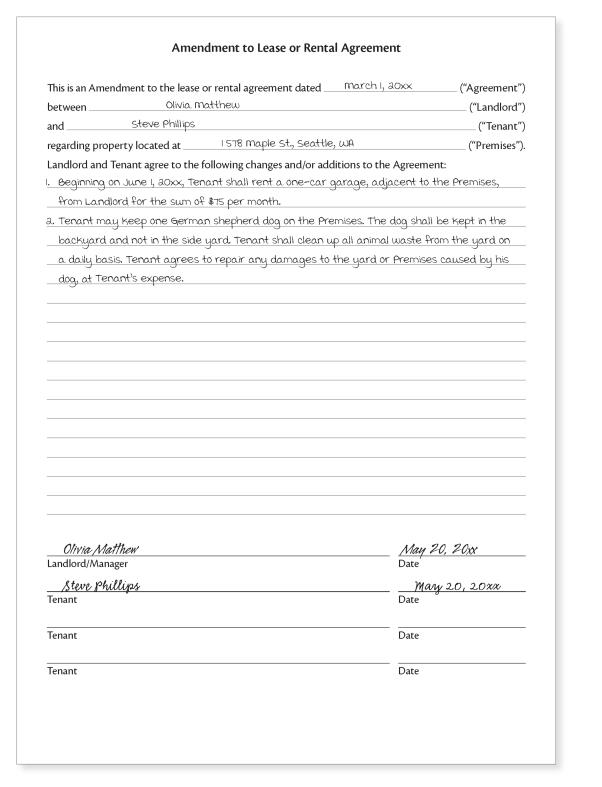
If the changes are lengthy, you can either add an amendment page to the original document or prepare a new rental agreement, as discussed below. If you use an amendment, it should refer clearly to the agreement it's changing and be signed by the same people who signed the original agreement. A sample Amendment to Lease or Rental Agreement form is shown below and the Nolo website includes a downloadable copy. See Appendix B for the download link.
Preparing a New Rental Agreement
If you want to add a new clause or make several changes to your rental agreement, it's best to substitute a whole new agreement for the old one. This is simple if you use the lease or rental agreement shown in this book (Chapter 2) and included on this book's companion page on Nolo's website. If you prepare an entirely new agreement, be sure that you write "Canceled by mutual consent, effective (date) " on the old one, and each of you should sign it. All tenants (and any cosigner or guarantors) should sign the new agreement.
The new agreement should take effect on the date that you cancel the old one.
To avoid problems, be sure there is no time overlap between the old and new agreements, and do not allow a gap between the cancellation date of the old agreement and the effective date of the new one.
TIP
A new tenant should mean a new agreement. Even when a new tenant is filling out the rest of a former tenant's lease term under the same conditions, you'll need to prepare a new agreement in the new tenant's name. See Chapter 8 for details on signing a new agreement when a new tenant moves in.
How Month-to-Month Tenancies End
This section discusses how you or the tenant can end a month-to-month tenancy.
Giving Notice to the Tenant
You can end a month-to-month tenancy simply by giving the proper amount of notice. No reasons are required in most states. Cities and states with rent control (such as Oregon, California, New Hampshire, and New Jersey) are exceptions, because landlords in these cities and states must have a just or legally recognized reason to end a tenancy. All you need to do is give the tenant a written notice, allowing the tenant the minimum number of days required by state law (typically 30) to move, and stating the date on which the tenancy will end (see "State Rules on Notice Required to Change or Terminate a Month-to-Month Tenancy" in Appendix A). After that date, the tenant no longer has the legal right to occupy the premises.
In most states, a landlord who wants to terminate a month-to-month tenancy must provide the same amount of notice as a tenant—typically 30 days. But this is not true everywhere. For example, in Georgia, landlords must give 60 days' notice to terminate a month-to-month tenancy, while tenants need only give 30 days' notice. (Ga. Code Ann. § 44-7-7.)
State and local rent control laws can also impose notice requirements on landlords. Things are different if you want tenants to move because they have violated a term of the rental agreement—for example, by failing to pay rent. If so, notice requirements are commonly greatly shortened, sometimes to as little as three days.
All states (and even some cities) have their own rules and procedures for preparing and serving termination notices. For example, some states specify that the notice be printed in a certain size or style of typeface. If you don't follow these procedures, the notice terminating the tenancy might be invalid. It is impossible for this book to provide specific forms and instructions for every rental situation. Consult a landlords' association or local rent control board and your state statutes for more information and sample forms (Chapter 18 shows how to do your own legal research). Your state consumer protection agency might also...
Get this document and AI-powered insights with a free trial of vLex and Vincent AI
Get Started for FreeStart Your Free Trial of vLex and Vincent AI, Your Precision-Engineered Legal Assistant
-
Access comprehensive legal content with no limitations across vLex's unparalleled global legal database
-
Build stronger arguments with verified citations and CERT citator that tracks case history and precedential strength
-
Transform your legal research from hours to minutes with Vincent AI's intelligent search and analysis capabilities
-
Elevate your practice by focusing your expertise where it matters most while Vincent handles the heavy lifting

Start Your Free Trial of vLex and Vincent AI, Your Precision-Engineered Legal Assistant
-
Access comprehensive legal content with no limitations across vLex's unparalleled global legal database
-
Build stronger arguments with verified citations and CERT citator that tracks case history and precedential strength
-
Transform your legal research from hours to minutes with Vincent AI's intelligent search and analysis capabilities
-
Elevate your practice by focusing your expertise where it matters most while Vincent handles the heavy lifting
