
Can I Vote?
| Citation | Vol. 7 No. 2 |
| Publication year | 2025 |
Can I Vote?
[Page 145]
Ramifications of False Claims to Citizenship and Emerging Initiatives for Noncitizen Voting
Olivia Serene Lee, Karl Krooth, Annette Wong, Shannon V. Reed, and Ron Hayduk *
Abstract: This article explores the rise of noncitizen voting in local U.S. elections and the challenges it creates for immigrants. While only citizens may vote in federal elections, some cities and states now allow noncitizens to vote locally, such as in school board or city council races. These efforts aim to recognize immigrants as community members with a stake in local decisions, but they also face lawsuits and political pushback. For immigrants, even lawful voting can carry risks, including confusion with unlawful voting or false claims to citizenship. The article offers guidance for navigating these complex and evolving rules.
Introduction
U.S. law immigration can be rife with contradictions. While it seems that comprehensive, beneficial reform moves at a glacial pace at the federal level (at least in the eyes of practitioners and beneficiaries), some changes can develop quickly, often at the local and state government level. Such is the case for noncitizen voting initiatives. Claiming citizenship when one is in fact not a citizen, or voting in a federal election, are well-established obstacles to citizenship. However, some states and local governments have moved to enable noncitizens to exercise their freedom of choice through voting in various types of nonfederal elections, which can impact the determination as to whether or not a noncitizen has made a false claim to U.S. citizenship. Is illegal voting truly a barrier to naturalization? How do we advise clients who are considering voting in such elections, or who have already participated in one of these elections? What is the current landscape of noncitizen voting in the United States?
Noncitizen Voting Initiatives
History of Noncitizen Voting in the United States
Noncitizen voting may sound like an oxymoron today, but between the 1700s and 1926, noncitizen voting in state and local elections was legally
[Page 146]
Figure 1. "Alien Suffrage" at the State Level Over the Decades
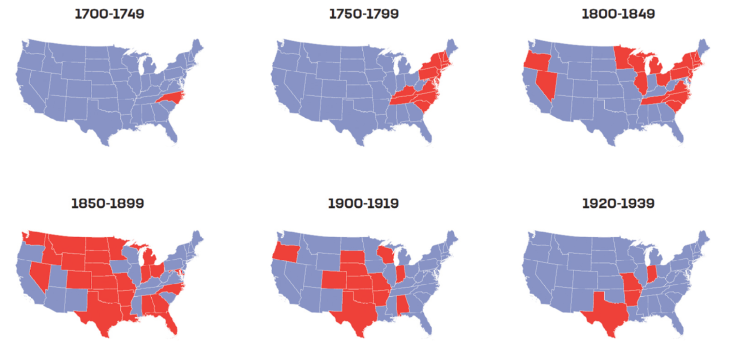
Source: Kimia Pakdaman, "Noncitizen Voting Rights in the United States," Berkeley Public Policy Journal, Spring 2019.
commonplace, until waves of xenophobia led to the ending of these rights in all states with Arkansas being the last state to eliminate noncitizen voting in 1926. 1 Prior to 1926, not only did noncitizen voting align with the rallying cry of "no taxation without representation" but it also fit within the paradigm of the time that land ownership and other key markers were more important prerequisites for voting than citizenship. See Figure 1.
In the past 30 years or so, noncitizen voting has gained a resurgence in popularity across the country. As of April 2025, 22 jurisdictions allow immigrants to vote in local elections: 16 municipalities in Maryland; 2 three in Vermont (Montpelier, Winooski, and Burlington); two in California (San Francisco and Oakland); and Washington D.C. 3 An additional dozen jurisdictions have considered restoring immigrant voting rights, including five localities in Massachusetts, five in California, one each in Maine and Illinois, and Connecticut. 4 See Figure 2.
Some jurisdictions provide voting rights to all residents, including both documented and undocumented immigrants (Maryland, San Francisco, Washington, D.C.) while other jurisdictions enfranchise only lawful permanent residents and those with work permits (Vermont, Massachusetts, Maine). Some jurisdictions empower immigrants to vote only in school board elections (San Francisco and Oakland) while others empower immigrants to vote for all local offices, from city council member to mayor (Vermont, Washington, D.C., Massachusetts). Some laws have been enacted via ballot proposals (San Francisco, Vermont), while others have been enacted by legislative processes (Maryland, Washington, D.C.).
Advocates have promoted these election reforms as a means to acknowledge immigrant residents as legitimate stakeholders, to affirm their voices in public
[Page 147]
Figure 2. Noncitizen Voting in the United States
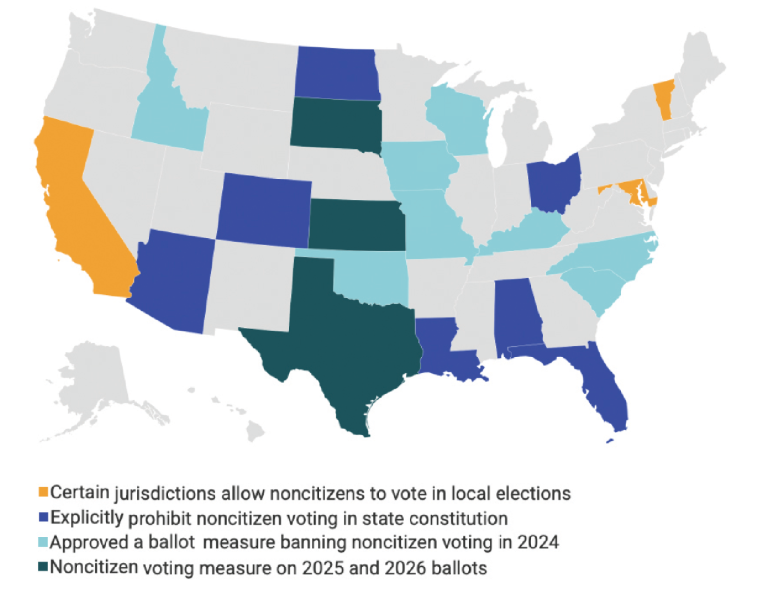
Note: The map indicates which U.S. states allow or prohibit noncitizen voting in elections for state or local offices. Data is current as of April 1, 2025.
Source: Ballotpedia.
affairs, and to advance their equitable inclusion. As such, these reforms create a form of "local citizenship." 5
This resurgence has also taken hold in California, where two localities, San Francisco and Oakland, passed measures allowing noncitizens to vote. San Francisco's noncitizen voting initiative for school board elections was passed in 2016 and implemented in 2018 for school board elections, and in 2021 noncitizens could also vote in school board recall elections. Noncitizens have voted in six school board elections between 2018 and November 2024. 6 In Oakland, voters passed Measure S in 2022, 7 which allows noncitizens to vote in local school board elections. However, the Oakland City Council has yet to pass a charter amendment to implement noncitizen voting. Most recently, in November 2024, voters in the city of Santa Ana rejected Measure DD, which would have extended voting rights to noncitizens in citywide elections. 8 The measure lost by 59.03 percent. 9
In other parts of the state, local governments have expressed interest in exploring noncitizen enfranchisement. In 2021, city council members in the
[Page 148]
city of Richmond, California, unanimously voted to explore enfranchising noncitizens in local elections. 10 However, as of this writing, nothing has been proposed as a ballot measure or charter amendment. In 2022, city council members of the city of San Jose, California, held a study session to explore the potential of enfranchising noncitizens in local elections. However, simultaneous lawsuits filed against San Francisco's noncitizen voting initiative and Oakland's ballot Measure S led the city of San Jose to put the discussion on hold until the lawsuits were resolved. Since those lawsuits were resolved in 2023, there has not been a formal movement to advance noncitizen enfranchisement in San Jose.
Lawsuits
As with many efforts to expand noncitizen voting, resistance comes in many forms, particularly through lawsuits.
New York City
In 2021, New York City's City Council passed legislation providing legal permanent residents and noncitizens who have work authorization with the right to vote in citywide elections after residing in New York for 30 days. Mayor Eric Adams allowed the legislation to become law in 2022. In 2023, representatives of the New York Republican State Committee and Republican National Committee, as well as a Democratic city council member, filed a lawsuit, Fossella v Adams, to stop the New York City legislation from being implemented, claiming that enfranchising 800,000 noncitizens would dilute the votes of U.S. citizens and violate the New York state constitution and state election laws. In June 2022, the New York Supreme Court for Staten Island sided with the challengers, agreeing that New York City's legislation violates the state constitution. In February 2024, the Appellate Division for the Second Judicial Department in New York upheld the lower court's ruling on appeal. 11 In March 2025, the New York State Court of Appeals affirmed the lower court's ruling, thus making New York City's legislation null and void. 12
Washington, D.C.
In 2022, the D.C. Council passed the D.C. Noncitizens Vote Act, which overcame bipartisan congressional opposition, and passed congressional review in 2023. That same year, a group of D.C. voters filed a lawsuit in D.C. Superior Court seeking to enjoin the law, citing dilution of the voting power of U.S. citizens and the fact that noncitizens do not have the right to vote or hold
[Page 149]
office. 13 The case, Stacia Hall v. the District of Columbia Board of Elections, was removed to the U.S. District Court for the District of Columbia where, in 2024, the court dismissed the lawsuit, reasoning that the votes of citizens will not be harmed by allowing noncitizens to vote. 14
In 2016, San Francisco voters passed Proposition N, which grants noncitizens who meet certain criteria the right to vote in school board elections. The eligibility criteria to vote as a noncitizen in San Francisco require the voter to be (1) a San Francisco resident who intends to remain so until the next Board of Education election; (2) the parent, legal guardian, or caregiver of a child living in San Francisco; (3) at least 18 years of age on Election Day; and (4) not disqualified from voting under state law for imprisonment or mental incompetence. The proposition was codified as a charter amendment in 2018 and implemented that November. In 2022, James Lacy filed a lawsuit to challenging the law after noncitizens had already voted in multiple elections, arguing that the San Francisco charter amendment violated the state constitution. 15 The charter amendment was ruled unconstitutional by a San Francisco Superior Court judge, but was subsequently reinstated in 2023 after the California Court of Appeal overturned the lower court's ruling and held that San Francisco's charter amendment was permissible under the state constitution and the city's charter. 16
In 2022, the Oakland City Council proposed ballot Measure S, which, if approved, would allow for a charter amendment to enfranchise noncitizen residents who met certain criteria to vote in school board elections. Weeks before the election was to take place, James Lacy, who had filed a lawsuit to discontinue San Francisco's noncitizen voting law, filed a lawsuit to stop the Oakland measure from appearing on the November 2022 ballot, claiming that the measure violated the California state constitution. The Alameda County Superior Court rejected this motion as...
Get this document and AI-powered insights with a free trial of vLex and Vincent AI
Get Started for FreeStart Your Free Trial of vLex and Vincent AI, Your Precision-Engineered Legal Assistant
-
Access comprehensive legal content with no limitations across vLex's unparalleled global legal database
-
Build stronger arguments with verified citations and CERT citator that tracks case history and precedential strength
-
Transform your legal research from hours to minutes with Vincent AI's intelligent search and analysis capabilities
-
Elevate your practice by focusing your expertise where it matters most while Vincent handles the heavy lifting

Start Your Free Trial of vLex and Vincent AI, Your Precision-Engineered Legal Assistant
-
Access comprehensive legal content with no limitations across vLex's unparalleled global legal database
-
Build stronger arguments with verified citations and CERT citator that tracks case history and precedential strength
-
Transform your legal research from hours to minutes with Vincent AI's intelligent search and analysis capabilities
-
Elevate your practice by focusing your expertise where it matters most while Vincent handles the heavy lifting
