
6.2 Microwave Radar Technology
| Library | Defense of Serious Traffic Cases in Virginia (Virginia CLE) (2020 Ed.) |
6.2 MICROWAVE RADAR TECHNOLOGY
6.201 How It Works.
A. Theory. Radar is the acronym for RAdio Detection And Ranging technologies. The police traffic radar unit emits an unmodulated continuous wave (CW) and measures reflections or "echoes" from moving vehicles. Reflections are frequency-shifted (Doppler shift) as the target
[Page 360]
vehicle moves, and the faster the target is traveling, the more the frequency shifts. A target that is traveling toward the radar shifts the frequency higher, while a target traveling away from the radar shifts the frequency lower as compared to the normal transmit frequency of the radar unit. The radar, by design, simultaneously transmits a continuous signal while receiving continuous signal echoes.
Moving-mode radar is slightly more complicated because the unit must also take into account the speed at which the police officer's vehicle is traveling. The target echo frequency is shifted by the relative speed between the target and radar unit that is also moving as the officer's car travels down the highway. For purposes of the radar measurement, the target vehicle's relative speed is the sum of the target and patrol car speeds for target vehicles that are traveling in the opposite direction—that is, meeting the moving police vehicle that is running radar. When measuring for a vehicle traveling in the same lane or direction as the police vehicle, the target's relative speed is the difference between the target and the speed of the patrol car.
B. Operation. All stationary microwave traffic radars can measure oncoming traffic; some models can also measure traffic that has passed the unit or "receding" traffic. All moving-mode radars can operate either from a stationary position or from a moving patrol car. All radars that are mounted to the patrol vehicle have a moving mode, and some have a second rear antenna. To function properly, moving mode requires the patrol vehicle to be traveling at a minimum speed between 5 and 20 mph. All moving-mode radars can measure opposite direction (opposite lane) traffic, and many can also measure same direction (same lane) traffic. Moving radars also measure and display patrol car speed (or "ground speed"). The antenna must be pointed directly forward, or directly aft for a rear antenna, to get accurate measurements. Although many radars can only track one target at a time, some models have the option to track and display two targets: the "strongest" signal, which may be either the closest or the largest target echo, and the fastest—or, in some cases, the faster—target in the beam.
C. Signal of the Unit. Microwave radars can be set to constantly transmit or to transmit on operator command ("instant-on"). All laser traffic radars only transmit on operator command ("instant-on"). A few microwave radars ("pulsed") transmit a very short burst that results in a speed measurement that is so unreliable the operator is not allowed to lock the speed. The "pulsed" mode is a marketing gimmick. Instant-on and pulsed (microwave) radars are intended to defeat radar detectors by keeping their transmission times short.
[Page 361]
D. Beamwidth. Most microwave traffic radars have a relatively wide beam of 10E to 25E that can easily cover several lanes of traffic at a relatively short range. The detection range within the beam varies with radar and target reflectivity and may be as low as 100 feet or less to distances of one mile or more. For this reason, an inherent problem in the technology is that a radar unit may track a distant large target instead of a closer small target without any indication to the operator of which target the unit is tracking.
E. The Cosine Effect. The angle between the microwave or laser radar and target (alpha in the figure below) must be small for the radar to measure speed accurately.
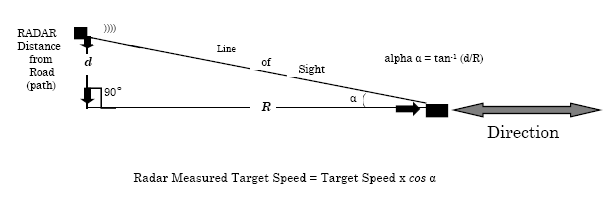
The angle is referred to as the Cosine Effect angle because measured speed is directly proportional to the cosine of this angle; the larger the angle is, the lower the measured speed will be. For this reason, the radar should be located as close to the road—or, more accurately, the projected target path that is to be measured—as is practical to minimize Cosine Effect errors in the readout. The Cosine Effect on moving-mode radar is slightly more complicated and may measure target speed higher than the vehicle's actual speed under certain conditions.
If an officer is operating a laser or microwave radar at some distance off the road, the Cosine Effect could be so severe that the radar would only measure a relatively small percentage of the actual target speed. In this situation, it is also quite possible the corrected target speed calculates excessively high, which indicates the radar was tracking some other target or signal. For example, if the cosine angle is 60°, the radar-measured speed is only half of the true target speed. If the officer states that, based on observation, the estimated target speed was about the same as the radar-measured
[Page 362]
speed (in this example only half of the true speed), one could argue that the officer's judgment was biased by the radar's readout. If the officer's estimated target speed conflicts with the speed indicated by the radar unit as corrected for Cosine Effect, which one is correct? The true answer is that perhaps neither one is right.
Another Cosine Effect deficiency, whether based on microwave or laser radar, concerns the issue of the unit's minimum range: targets that are inside the unit's minimum range are not measured because their relative speed is changing too quickly. A target inside minimum range could be the closest target to the operator, but if another target is outside minimum range but still close enough for the radar to measure its speed, a radar operator could mistake the radar reading as coming from the closer target that is inside the unit's minimum range, instead of the more distant target that is really the one producing the reading.
The farther the unit is off the target's path (lane of travel), the greater the Cosine Effect and the greater radar's minimum range becomes. Although radar sample time, speed tolerance (or accuracy), and target speed are also factors, distance off the target lane is the factor with...
Get this document and AI-powered insights with a free trial of vLex and Vincent AI
Get Started for FreeStart Your Free Trial of vLex and Vincent AI, Your Precision-Engineered Legal Assistant
-
Access comprehensive legal content with no limitations across vLex's unparalleled global legal database
-
Build stronger arguments with verified citations and CERT citator that tracks case history and precedential strength
-
Transform your legal research from hours to minutes with Vincent AI's intelligent search and analysis capabilities
-
Elevate your practice by focusing your expertise where it matters most while Vincent handles the heavy lifting

Start Your Free Trial of vLex and Vincent AI, Your Precision-Engineered Legal Assistant
-
Access comprehensive legal content with no limitations across vLex's unparalleled global legal database
-
Build stronger arguments with verified citations and CERT citator that tracks case history and precedential strength
-
Transform your legal research from hours to minutes with Vincent AI's intelligent search and analysis capabilities
-
Elevate your practice by focusing your expertise where it matters most while Vincent handles the heavy lifting
